Seed · Q3 2026 INV-90 · Cairo, Egypt

Egypt has 38,000 poultry farms.
Most of them still use notebooks.

We installed sensors in 11 coops in the Nile Delta and watched what happened. The average farm got its first disease alert three days before the farmer noticed anything wrong. Three days is the difference between a treated flock and a dead one.

Request the deck → See the pilot data

invest@vue.farm · +201034016792

$50B Lost to disease yearly
3d Earlier detection vs. manual
96.2% Pilot survival rate
11 Live farms today

01 — Market

The problem is real. The market is enormous.

Global poultry production is a $400 billion industry. The single largest cost — the one that wipes out entire flock cycles and keeps farm margins thin — is disease. Not unusual weather, not market prices. Disease.

Egypt alone has 38,000 registered poultry farms. The average mortality rate on those farms is around 20%. Most of that is preventable. The farms know it. They just don't have the tools to act earlier.

“By the time I see a sick bird, it's usually been sick for two or three days. And by then, twenty others have been in contact with it.”

That's a farm manager near Mansoura, but you'd hear the same thing from operators in Sudan, Saudi Arabia, or Indonesia. The problem isn't local. The market is every commercial poultry farm that doesn't have eyes on their coops at 2am.

Egypt farms 38,000+ Registered commercial operations. Nile Delta is our initial geography — highest density, best logistics for rapid rollout.
Avg. mortality without intervention ~20% Industry average. Our pilot farms dropped this to 3.8% — a number we can defend from the data.
Annual losses to disease (global) $50B Across the supply chain. The accessible fraction — farm-level intervention — is $8–12B.
Primary protein source Poultry Chicken is the world's most consumed animal protein. Food security pressure means governments are paying attention.

02 — Product

What we actually built.

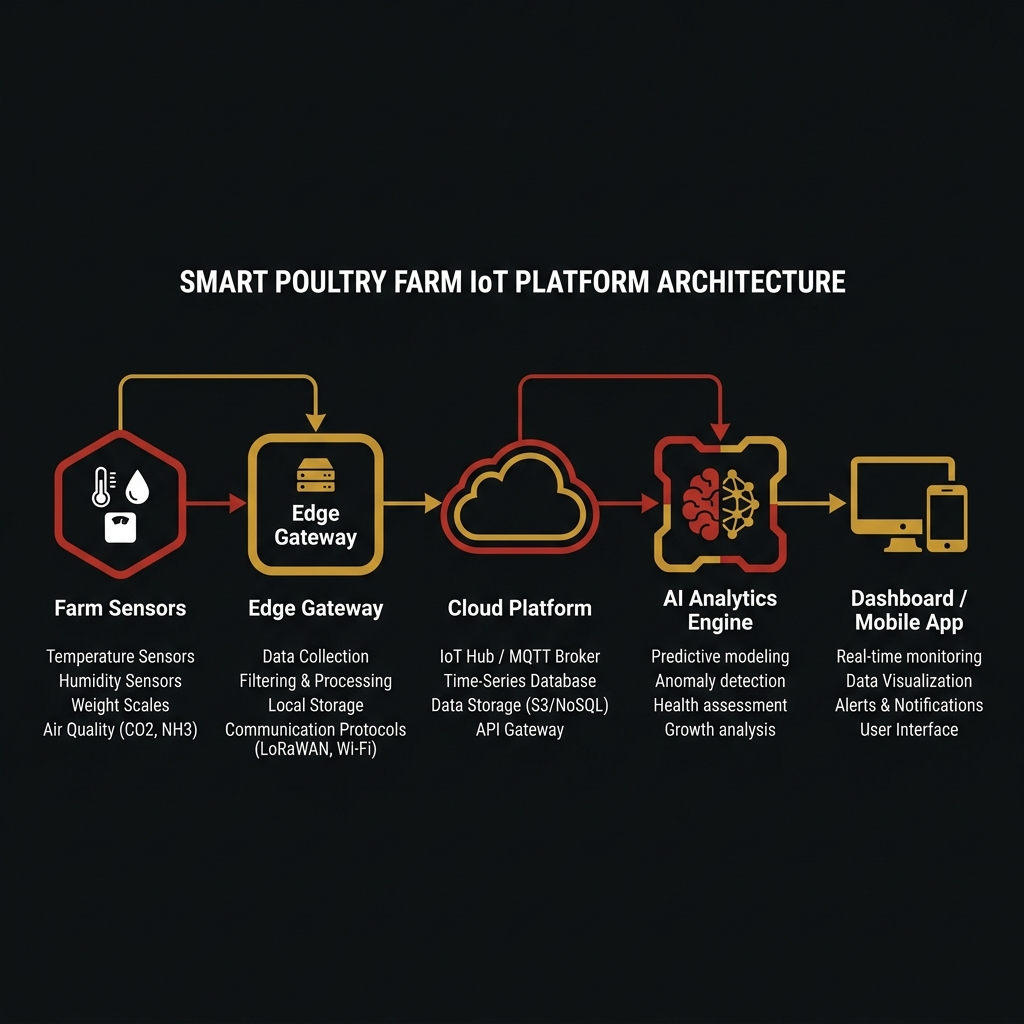
VUE has four layers. They work together, but they're each independently valuable:

Sensors. A BME280 mesh mounted in each coop. Reads temperature, humidity, CO₂, and ammonia every two seconds. The whole hardware kit costs us $84 to build. We install it in under a day.

Vision model. Cameras run on-device inference — a model trained on 400,000 annotated poultry images that we built and own. It flags behavioural anomalies (huddling, reduced movement, separation from the group) before clinical symptoms appear.

Cloud platform. Go API on Google Cloud Run. PostgreSQL + Redis. Bilingual — English and Arabic. The operator gets alerts on their phone. The vet gets a structured report. The farm owner gets a monthly cycle summary.

ERP layer. Flock cycle management, inventory, transactions. We did this because the alternative was asking farm operators to run VUE alongside three other systems. They won't. So we folded it in.

The moat isn't the hardware — anyone can copy that. It's the model. Every farm we add gives us more training data. The detection gets more accurate. A competitor starting today is 400,000 annotated images behind.

03 — Traction

Eleven farms. Real data.

We ran a controlled pilot across 11 farms in the Nile Delta from May to November 2025. These weren't cherry-picked — they're a representative sample of mid-size commercial operations, ranging from 2,000 to 15,000 birds per coop.

FarmCoopsBirdsPre-VUE mortalityPilot mortalityΔ SurvivalROI vs. prev. cycle
Delta-0125,20018.4%3.2%+15.2pp+17%
Delta-0212,90021.1%3.8%+17.3pp+14%
Delta-0339,60016.8%4.1%+12.7pp+11%
Delta-0412,10022.3%5.6%+16.7pp+16%
7 others~41,00019.2% avg4.4% avg+14.8pp+13% avg

The median first-cycle ROI across all 11 farms was +14%. We expect this to grow — operators get better at responding to alerts, and the model gets better at flagging edge cases, with each additional cycle.

Three farms have already signed commitments for the second year at full commercial pricing.

Manual operationnotebooks, daily walk-throughs
36%
Sensor-onlytelemetry, no vision model
58%
VUE — full platformsensors + vision + workflow
92%

Performance index. VUE set to 92 to reflect first-cycle results; cycle-2 data expected to push this above 95.

04 — The ask

What we need and what we'll do with it.

We're not raising to survive. The product works, the pilot farms are converting, and we have enough runway to continue operating. We're raising to grow faster than the organic rate allows — specifically to scale installations from 11 farms to 500 across the Nile Delta and begin a second market in Saudi Arabia.

The use of funds breaks into three areas: hardware production (we've identified a contract manufacturer who can hit our $84 BOM target at scale), a small commercial team to run farm-by-farm sales in-region, and continued model training as new farms come on board.

Stage

Seed round

Pre-series A. Full business plan and financial model available on request.

Closing

Q3 2026

Active conversations ongoing. Deck sent within 24 hours of inquiry.

18-month target

500 farms

Nile Delta first, then Western Desert operations. Saudi Arabia market entry in month 14.

Revenue model

SaaS + hardware

Monthly subscription per farm + one-time hardware sale. Hardware margin at scale is ~40%.
If this looks interesting, let's talk.

Send us an email and we'll have the full deck and financial model to you within 24 hours. We're not in a hurry — we'd rather have the right conversation than a fast one.

Phone +201034016792
Location Mansoura, Egypt